The Department of Environment’s most recent estimates – released last weekend – find that Australia’s emission will rise to 577 Mt by 2020 – 3 per cent above 2000 levels.
>more> RenewEconomy
The Department of Environment’s most recent estimates – released last weekend – find that Australia’s emission will rise to 577 Mt by 2020 – 3 per cent above 2000 levels.
>more> RenewEconomy
 Send a message now to our political party leaders and let them know that they need to reject this report and stand up to the fossil fuel industry once and for all.
>more> GreenPeace
Is this what we really need, more biofuel ethanol for cars, with track record that “well to wheel analysis”(from preparing to plant feedstock crop, all the way to in vehicle tank) that it takes more energy to produce than it yields. It turns out that this is for export! Super sweet sorghum and sugar cane, now ain’t that what’s needed more of, in north Queensland, coaxed along by cocktail of agrochemicals, of course.

“I posted last week the news that Saudi Arabia seems to have recognized that the age of Oil is drawing to an end. Below, Amory Lovins Whale oil analogy might have seemed quixotic a few years ago. Now?
“Yet as oil prices gyrate, it’s important to understand that underlying trends are shifting too, to oil’s disadvantage. It’s happened before. In the 1850s, whalers—America’s fifth-largest industry—were astounded to run out of customers before they ran out of whales. Over five-sixths of their dominant market (lighting) vanished to competitors—oil and gas both synthesized from coal—in the nine years before Drake struck “rock oil” (petroleum) in Pennsylvania in 1859. Two decades later, Edison’s electric lamp beat whale oil, coal oil, town gas, and John D. Rockefeller’s lighting kerosene. Today in turn, most traditional lighting is being displaced by white LEDs, which each decade get 30x more efficient, 20x brighter, and 10x cheaper. By 2020 they should own about two-thirds of the world’s general lighting market.”
>more> ClimateCrocks/RMI
BOTTOM LINE: Gates is just wrong about everything here. He is wrong that energy miracles are needed by the industrialized countries to achieve CO2 levels in 2050 consistent with beating the 2°C target. He is wrong that achieving that target requires focusing on R&D rather than deployment. He is wrong that there is some sort of consensus to that effect. He is wrong that a carbon price isn’t important in achieving the rapid reduction the rich countries need. He is wrong to make it seem like boosting energy efficiency is not as vital a strategy as reducing carbon intensity.
>more> ThinkProgress
“joined the global community of certified Benefit Corporations! Importantly we are ranked in the top 10% of B Corps globally and are the only co-operative certified in Australia…Certified B Corporations are leaders of a global movement of people using business as a force for good. They meet the highest standards of overall social and environmental performance, transparency and accountability and aspire to use the power of business to solve social and environmental problems. There are more than 1,700 Certified B Corporations in over 130 industries and 50 countries with 1 unifying goal – to redefine success in business.”
>more> HepburnWind
So much recent action on Uni campuses in Australia has earned media attention, even internationally, with some success but setting the stage for more action with more members:
 Just a day after MP Ewen Jones put case for climate funds to finance 1.2GW coal fired power station near Townsville, Coalition Senate leader and attorney-general George Brandis revealed why the government thinks this might be a good idea….The new research on the Great Barrier Reef shows that more than 90 per cent of the reef has been affected by bleaching. Worse, some 40% not merely bleached, it has died, putting at risk some of the 70,000 jobs that rely on the tourism market, not to mention the trillions of dollars in biodiversity value.
In reference to Brandis’ comments, Waters said it’s time for government to wake up to “scientific reality, that global warming is destroying the Reef and continuing with Abbott’s woeful climate policies won’t help it…“The coal industry is dying and leaving workers in the lurch, while in contrast clean energy industry is taking off and can provide thousands of new jobs without sacrificing our Reef or our very way of life.”…But, it seems, mainstream media just ain’t interested…as far as we can tell, not a single mention in print in Australia. Not one word. But then, Brandis’ denial of climate science didn’t rate a mention either.
>more> RenewEconomy
 Turnbull Coalition government has kicked off its informal re-election campaign by repeating its desire to build a massive coal fired power station
in north Queensland, only this time it proposes to use climate funds to help pay for the project. In confirmation that little has changed in switch from Abbott to Turnbull regimes, Queensland MP Ewen Jones became latest member of Coalition to outline federal government’s plan for future energy innovation: more fossil fuels…On same day as compelling economic case for shifting Australia to 100 per cent renewable energy is published, and just days ahead of Australia signing the Paris climate agreement, Jones suggested that government could use funds from Direct Action, as well as the Clean Energy Finance Corporation and the northern Australian infrastructure fund, to support development of a 1.2GW coal-fired generator in north Queensland.
>more> RenewableEconomy
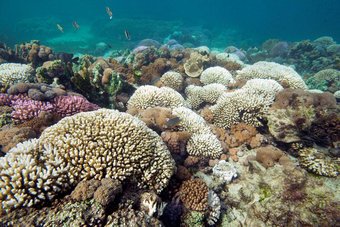 The National Coral Bleaching Taskforce conducted aerial surveys and underwater dives in 911 individual reef sites. They concluded between 60 and 100 per cent of corals were severely bleached on 316 reefs, with nearly all in the northern half of the Reef. Professor Terry Hughes, who convened the taskforce, says scientists are continuing to measure the ongoing impact of the bleaching. He points out that dead 200 year old corals will obviously not re-generate in his lifetime.
>more> ABC_RN
Why rent a lawyer when you can buy a judge
A blog by Julian Cribb
Learning Instrumentation and Control System based on case study
Sharing solutions that make the climate safer and our communities more liveable
Just another WordPress.com site with thoughts by Marcus Ampe
with Peter Sinclair
Writing about writing and the News Media.
Or why the world is going to hell
News and analysis for the clean energy economy
 groundswell bass coast climate change renewable energy