100km of kelp forest died following a marine heatwave in 2011 which saw the ocean temperature increase by 2C…death of the kelp caused functional extinction of 370sq km of rocky cool-climate reefs, extending down the coast from Kalbarri, about 570km north of Perth, Western Australia.
https://interactive.guim.co.uk/uploader/embed/2016/07/reef_map-zip/giv-12515GfjIQQoNlBTo
Photograph: Darryl Torckler/Getty Images
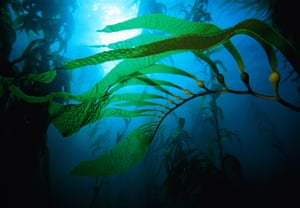
….suggested southern kelp forests were more able to withstand heatwaves than northern kelp forests, Prof Craig Johnson, from the University of Tasmania’s Institute for Marine and Antarctic Studies, told the Guardian…He agreed with Wernberg that it was likely kelp forests would retract to the southern-most corners of the continent as temperatures warmed, which would see the majority of species dependent on the reef pushed out. Tasmania’s remaining giant kelp forests appear to have been more resilient to the heatwave…Tasmania has already lost 95% of its giant kelp forests, due to ocean warming over the past 80 years, but remaining species appear more resilient. The species grows so fast you can measure it in the morning and come out after lunch to find it’s grown another 30cm. Johnson said the value of the Great Southern Reef was “completely under-appreciated,” and that the number of endemic species was “orders of magnitude more on the Great Southern Reef than the Great Barrier Reef”…The study, Climate-driven regime shift of a temperate marine ecosystem, was published in the journal Science on Thursday
>more> TheGuardian
 Whereas GISS director Dr. Gavin Schmidt had been saying there was roughly a 99 percent chance that 2016 would top 2015, he tweeted Monday that “With data now available through September, 2016 annual record (~1.25ºC above late 19th C) seems locked in.”..Indeed, it now appears 2016 will crush previous record for hottest year, set in 2015, which itself crushed previous record for hottest year that was set in 2014 — a three-year run never seen before in the 136-year temperature record.

 Clouds are now moving poleward because of a northward shift in the storm tracks due to the expansion of circulation patterns in the tropics. As a result, these clouds are reflecting less sunlight back out to space than they did at lower latitudes because less sunlight is hitting them when farther north.
 One thing it won’t need, is more “base-load” generation. As RenewEconomy pointed out last week, there is no room for additional baseload in the state, just for more “flexible” capacity such as storage. The MEI reinforces that, and says that the baseload need in South Australia is for “minus” 210MW.



 groundswell bass coast climate change renewable energy