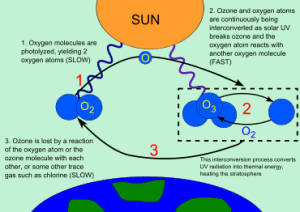
 Reductions of up to 70% in the ozone column, observed in southern hemisphere spring over Antarctica, and first reported in 1985 (Farman et al.) are continuing. Since the 1990s, Antarctic total column ozone in September and October continued to be 40–50% lower than pre-ozone-hole values…The hole in the Earth’s ozone layer over the South Pole has affected atmospheric circulation in the Southern Hemisphere all the way to the equator.[94] The ozone hole has influenced atmospheric circulation all the way to the tropics and increased rainfall at low, subtropical latitudes in the Southern Hemisphere… James Lovelock had recently discovered, during a cruise in the South Atlantic in 1971, that almost all of the CFC compounds manufactured since their invention in 1930 were still present in the atmosphere…Americans voluntarily switched away from aerosol sprays before legislation was enforced, while climate change failed to achieve comparable concern and public action.[28] The sudden recognition in 1985 that there was a substantial “hole” was widely reported in the press. The especially rapid ozone depletion in Antarctica had previously been dismissed as a measurement error.[30] Scientific consensus was established after regulation.[27]
>readmore> Wikipedia


 groundswell bass coast climate change renewable energy